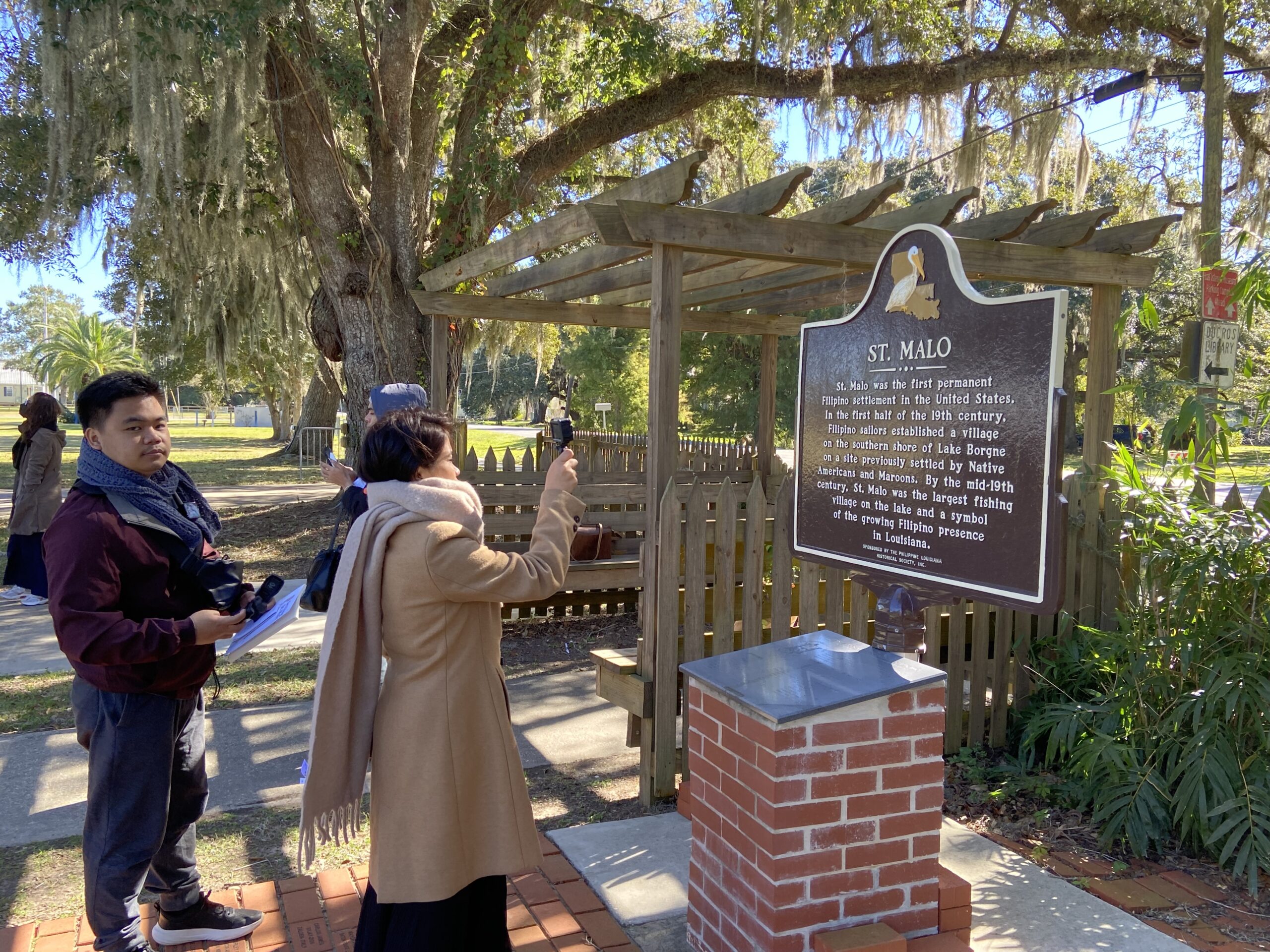
Storytellers: From the Philippines to St. Malo
From Tourist Visit to Transnational Documentation
In November, four Filipino content creators visited coastal Louisiana to document the history of St. Malo, the nineteenth-century Filipino fishing settlement once located on Lake Borgne. Their visit included Shell Beach, the St. Malo historical marker, the French Quarter, and Faubourg Marigny—sites connected to maritime labor, boarding houses, Mardi Gras culture, and the layered history of Filipino presence in the Gulf South.
In the months that followed, three videos were released in the Philippines. Each approaches St. Malo from a distinct perspective, demonstrating how history shifts across medium, audience, and national context.
Jonas Tayaban
Jonas Tayaban approaches the settlement through environment and labor. His documentary situates St. Malo within the ecological realities of the Louisiana marsh and highlights connections to African maroon communities and Indigenous peoples. Maritime work, shrimp drying, and survival strategies anchor his interpretation, emphasizing how early Filipino presence complicates conventional immigration narratives.
Jacque Manabat
Jacque Manabat’s video emphasizes dialogue and contemporary reflection. Through interviews and on-site footage, she situates St. Malo within broader discussions of Filipino identity and diaspora. Her framing lingers on the act of looking—across Lake Borgne toward a village erased by storms and erosion—and asks what it means to search for a place that no longer physically exists.
Hello Shayne
Hello Shayne presents St. Malo through the language of freedom and migration. Addressing a Filipino audience directly, she connects the Manilamen to colonial history and the Manila–Acapulco Galleon Trade. Her video extends the timeline of Filipino presence in the United States, reframing St. Malo not as a footnote in American history, but as part of Philippine history.
A Story in Circulation
For decades, Filipino Louisiana was documented primarily by visiting journalists, travelers, and historians. These recent works mark a shift: Filipino creators are now telling the story to audiences in the Philippines, situating the Gulf South within a shared diasporic landscape.
The physical site of St. Malo continues to erode. Archival gaps remain. Dates are still debated. Yet the narrative has expanded beyond regional memory and returned across the Pacific.
The shoreline may recede, but the story continues to circulate.